
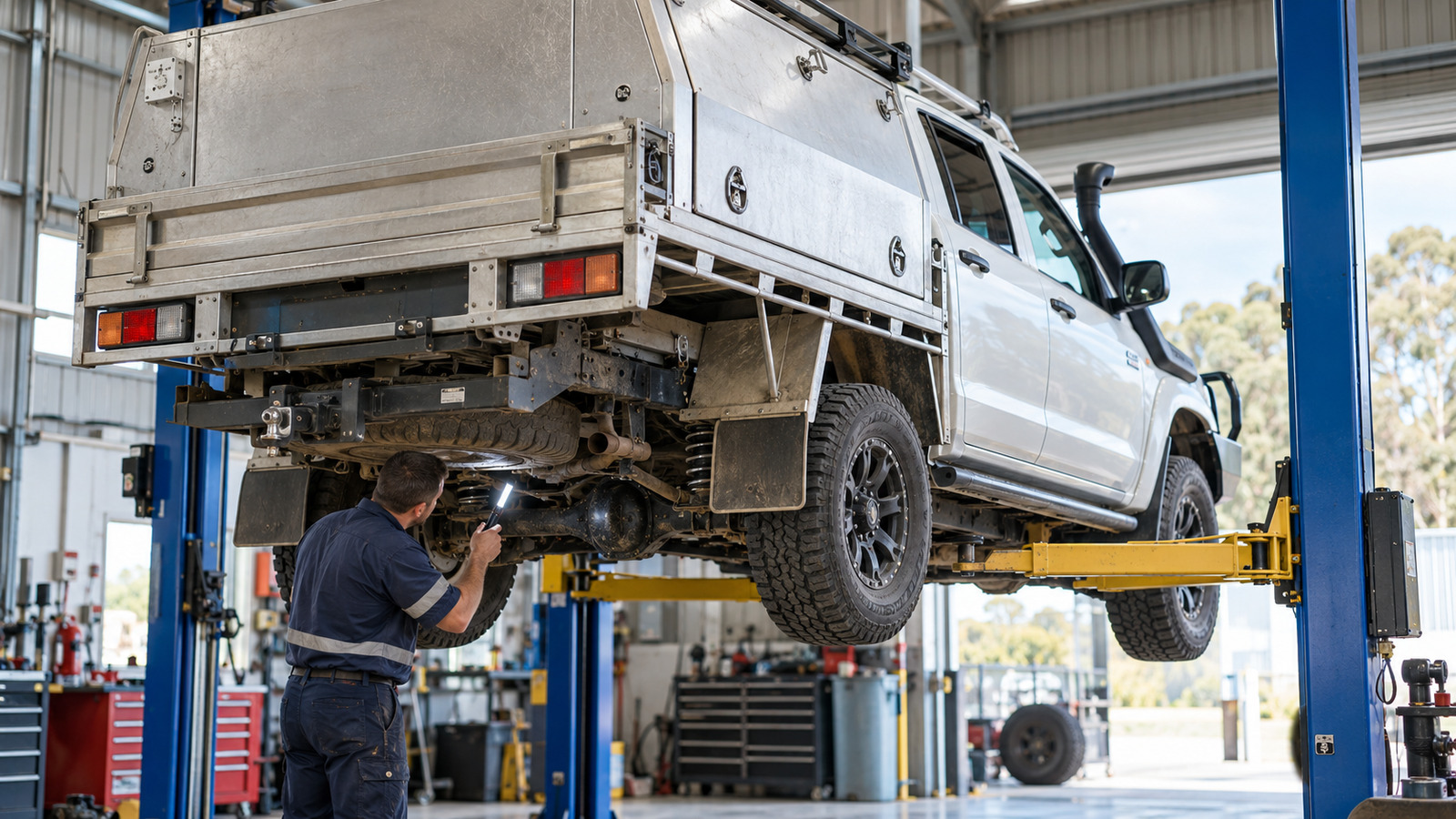
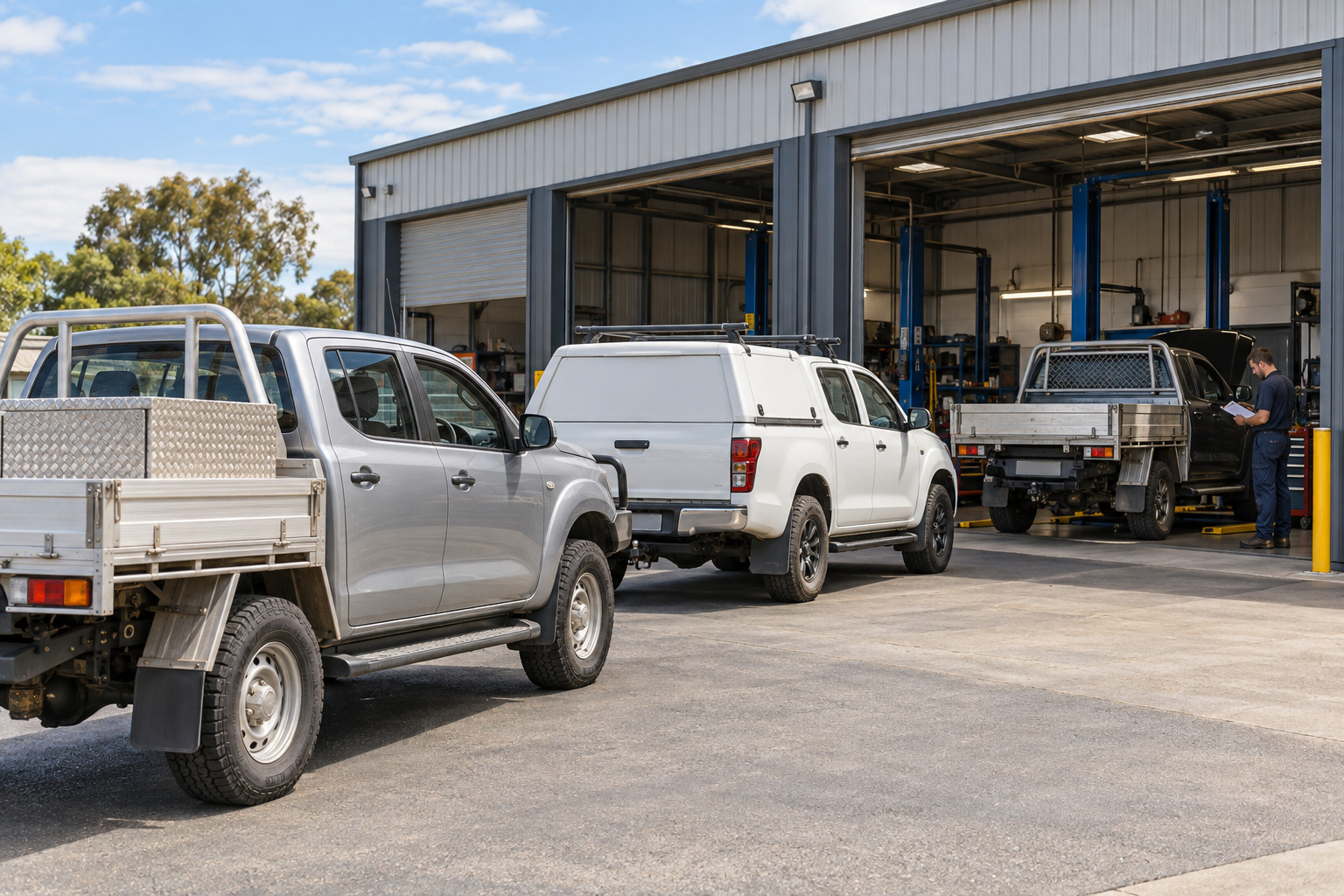
A roadworthy for work vehicles turns on different things from a roadworthy on a family car. The faults come from load, towing and kilometres rather than from age. Suspension, brakes, trailer wiring and tyres are the four that catch work vehicles out.
This is written for fleet managers, tradespeople with two or three utes, and small businesses around Colac. Everything below is about the work vehicles, not the family car.
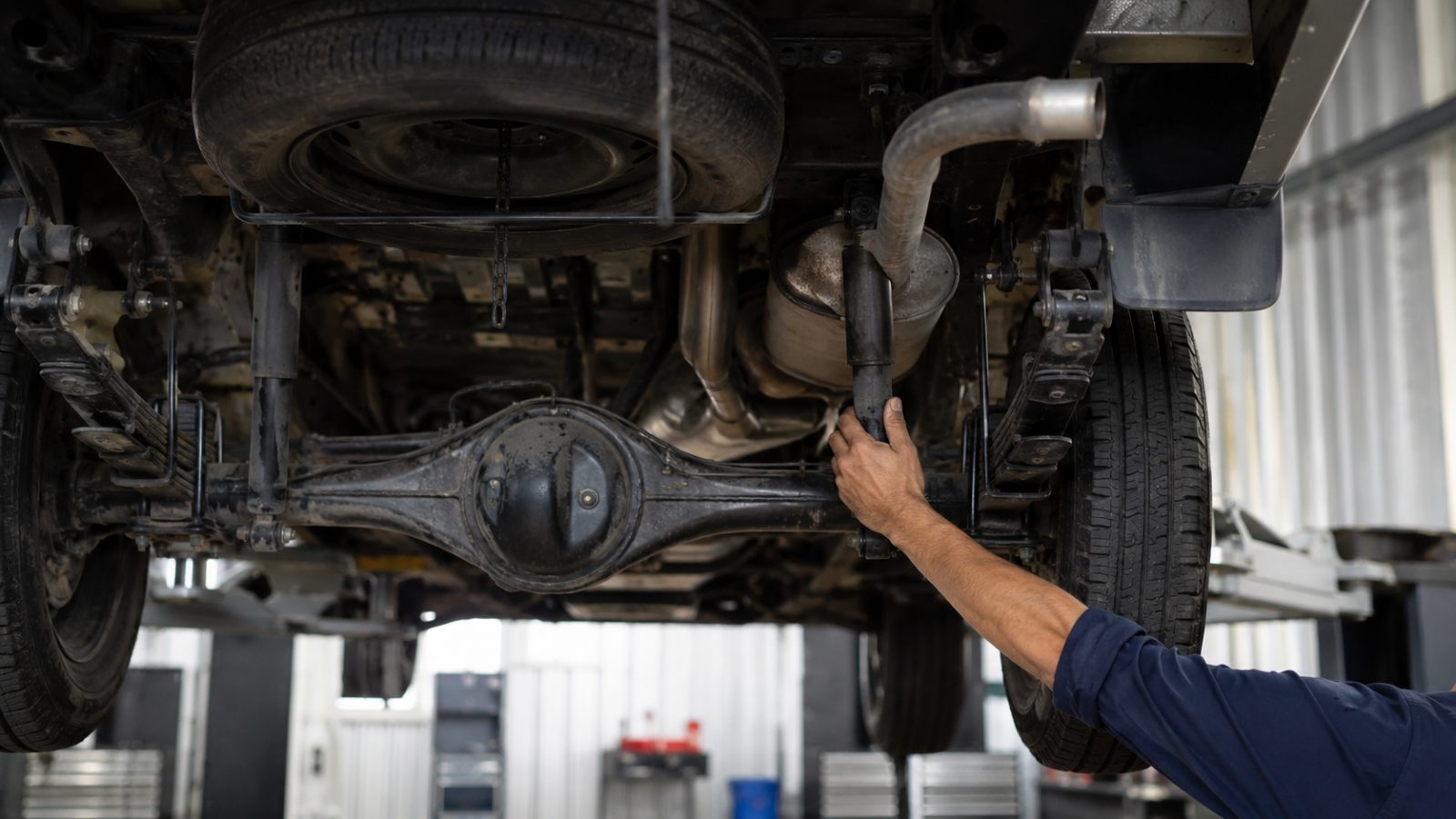
On a work ute, most failures trace back to weight. Load and unsealed roads wear the same parts a private car has, only faster. A three year old ute that is loaded daily can fail on items a ten year old hatchback passes. Age is a poor guide on a work vehicle.
Windscreen damage is judged on where it sits, not on how big it looks. The area the driver’s side wiper sweeps is what a tester weighs up.
| Item | What wears it on a work vehicle | What the driver notices |
|---|---|---|
| Springs and shock absorbers | A tray or canopy loaded most days holds the suspension compressed, so it wears by load rather than by years | The back sits low, or the rear bottoms out on a driveway it used to clear |
| Brake pads and discs | Towing puts more work through the same brakes on every stop, and a heavy payload does the same | Longer stopping when loaded, or a grinding noise that was not there empty |
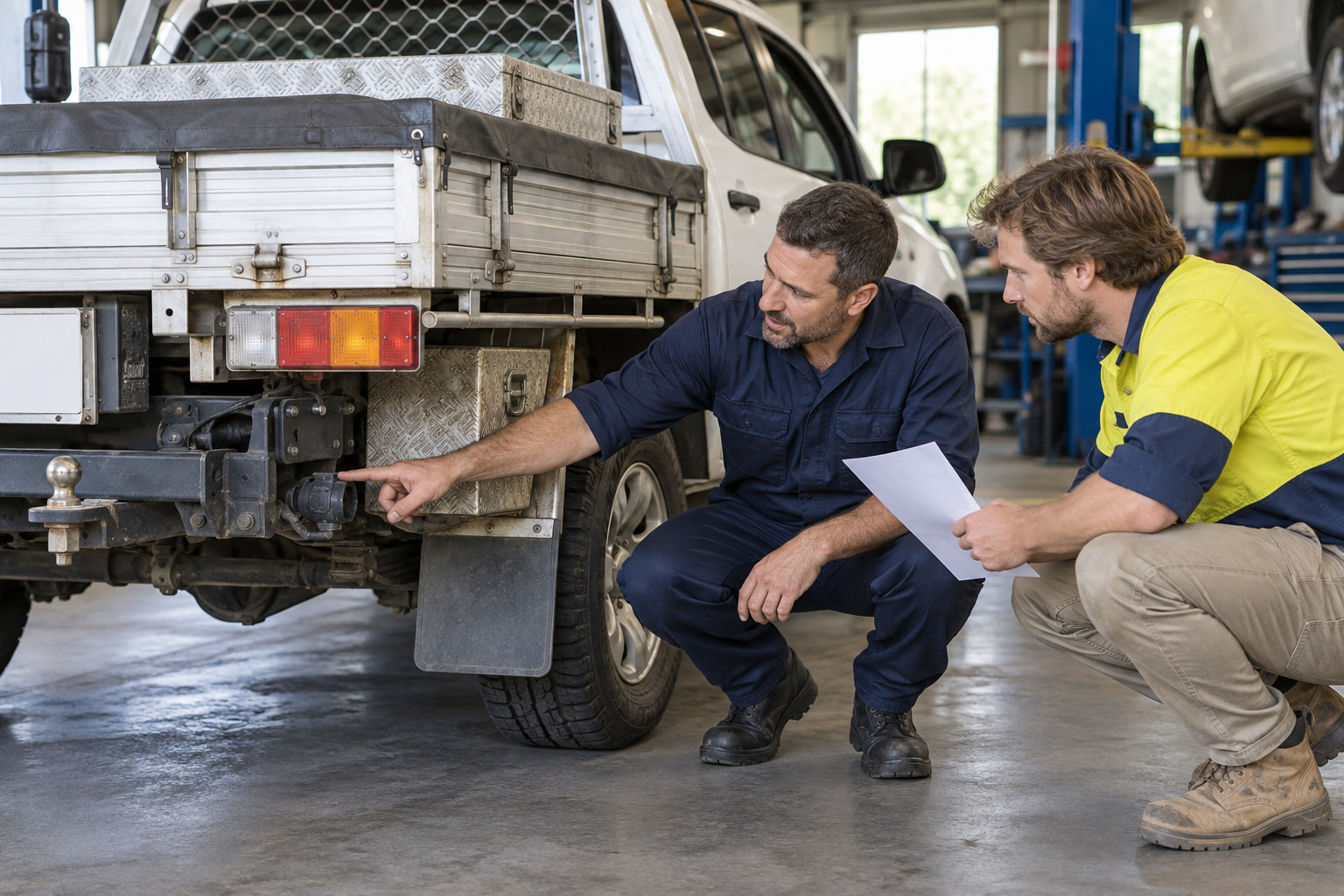
| Trailer plug, tray lights and canopy wiring | Circuits added after the vehicle was built, then exposed to water, dust and plugging in and out | A trailer indicator that stops working, or a brake light out on the tray |
| Underbody and body corrosion | Gravel strips paint and underbody coating, and rust starts in the chips it leaves | Rust bubbling around the tray mounts, the sills or the rear guards |
| Windscreen | Stones thrown up on unsealed roads chip the glass in the same place every time | A chip in front of the driver that has spread into a crack |
A fit-out is not a fail on its own. A canopy, a roof rack or a tray is fine by being there. What matters is the mounting, and whether anything now blocks a light or a number plate.
Tow bars have their own rule. A tow bar has to meet ADR 62, the Australian Design Rule for mechanical connections between vehicles. It also has to carry a marking showing the weight it is rated to tow. A bar rated below the load behind it is a safety problem, not a paperwork one.
Tyres are the other common one. A loaded work vehicle scrubs tyres unevenly. It reaches the tread limit sooner than a car doing the same kilometres empty. Tyres are not fitted here, so a tyre place will need to sort that before the vehicle comes in.
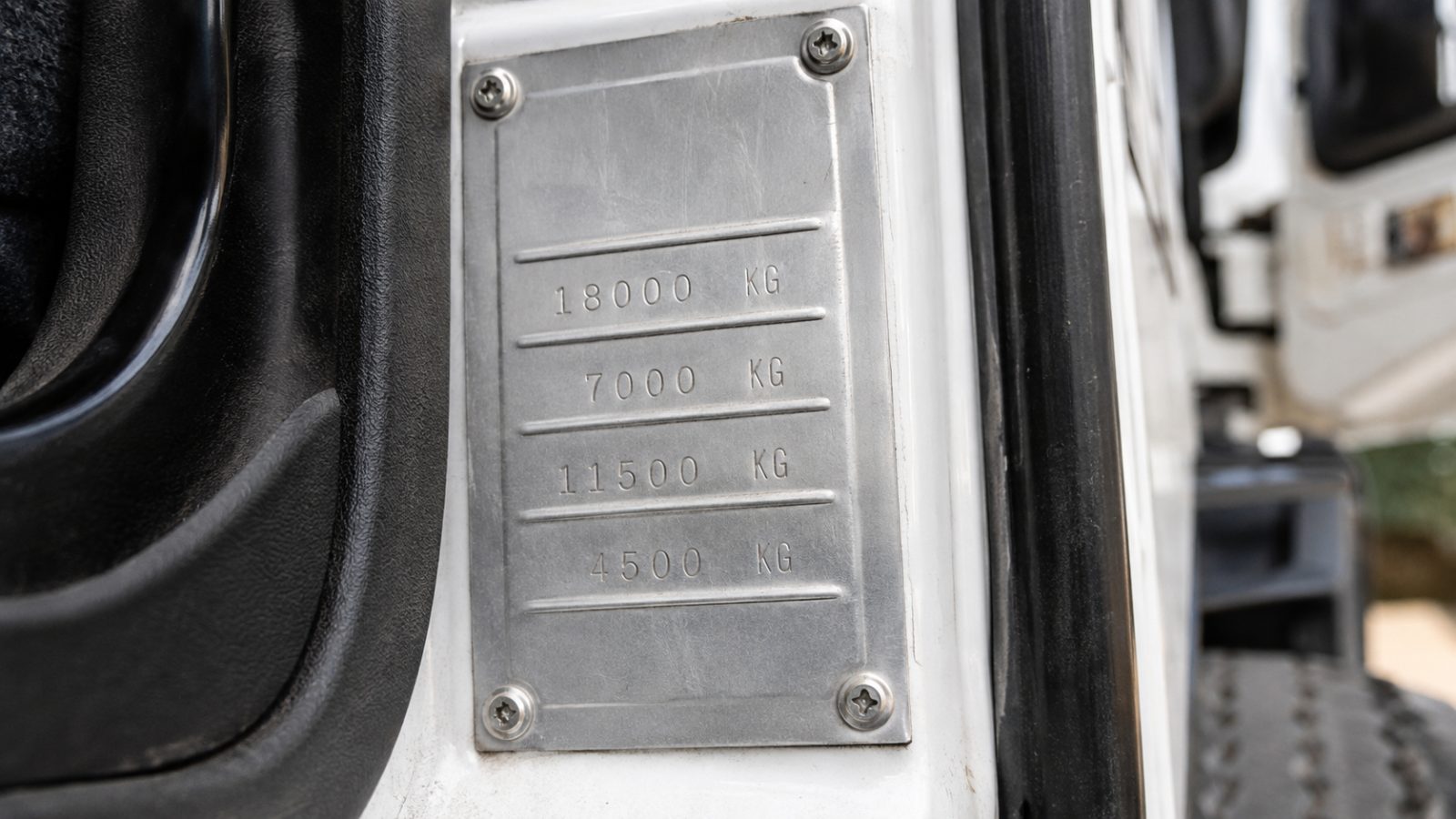
The dividing line in Victoria is gross vehicle mass, and it sits at 4.5 tonnes. Below it, a truck goes through the same light vehicle system as a ute. Above it, the truck counts as a heavy vehicle. The inspection then runs under a different scheme, and not every tester is approved for it.
So read the compliance plate before you book anything. GVM is stamped on it, and that number decides which system the truck sits in. The work here covers light and medium trucks rather than heavy ones. Have the GVM to hand when you ring about truck and commercial vehicle repairs.
Getting it wrong costs a day. The nearest alternatives are in Geelong, about 75 km away and about an hour each way. A truck turned away locally is a return trip somebody has to drive.
Where a regional business services its fleet is a bigger decision than one inspection. There is a separate piece on choosing between a dealer and an independent workshop.
A defect notice is a formal instruction about a vehicle. An officer issues it after inspecting the vehicle, usually at the roadside. It is recorded against the registration, and it has to be cleared.
Worth knowing. A defect notice is not the same as failing an inspection you booked. A fail is a job list from the workshop you chose. Nothing is recorded against the vehicle. A defect notice comes from an officer and sits on the registration record. It has to be formally cleared. The two get mixed up often, and the difference decides whether the vehicle can be driven.
In Victoria a defect notice can come from Victoria Police. An authorised vehicle inspector or an Environment Protection Authority officer can also issue one.
Notices come in two kinds. A minor defect notice covers a fault that could become a safety risk if it carries on. That includes a danger to a person, to property or to the environment. A major defect notice is the stronger one. It is issued where further use after the time on the notice would be an imminent and serious safety risk.
A light vehicle notice carries a prohibit time, and that time governs everything. After it passes, the vehicle stays off the road. If it is unsafe, or the time has gone, it moves on a tow truck or a trailer.
Some notices come with a label stuck to the windscreen and some do not. That changes whether the vehicle itself has to be presented to clear the notice.
Clearing one follows what the notice says. Usually that means fixing the listed faults first. Then you need a certificate of roadworthiness dated after the notice was issued. That certificate, and often the vehicle, goes to VicRoads, and a clearance fee applies.
Only a Licensed Vehicle Tester may issue a certificate of roadworthiness in Victoria, from premises approved for it.
Do not let it sit. Registration can be suspended if the notice is not cleared. The window is 28 days from the date it was issued. The timing rules that follow a failed inspection are a separate mechanism, and they do not carry across.
Certificates are easier to plan than to react to. A business with several vehicles can pick when each one gets inspected. That beats finding out on the day somebody needs the ute. Where the vehicles already come in together for fleet servicing, the certificates can follow the same schedule.
Three things make the difference:
The useful question on a work vehicle is not whether it will pass. It is when it needs to.
Timing matters because a certificate does not last indefinitely. A Victorian certificate of roadworthiness is current for 30 days from the date of issue. An inspection booked months before a vehicle changes hands is money spent twice.
The scheduling side of running a fleet through one workshop is covered separately. There is a piece on booking a whole fleet in online.
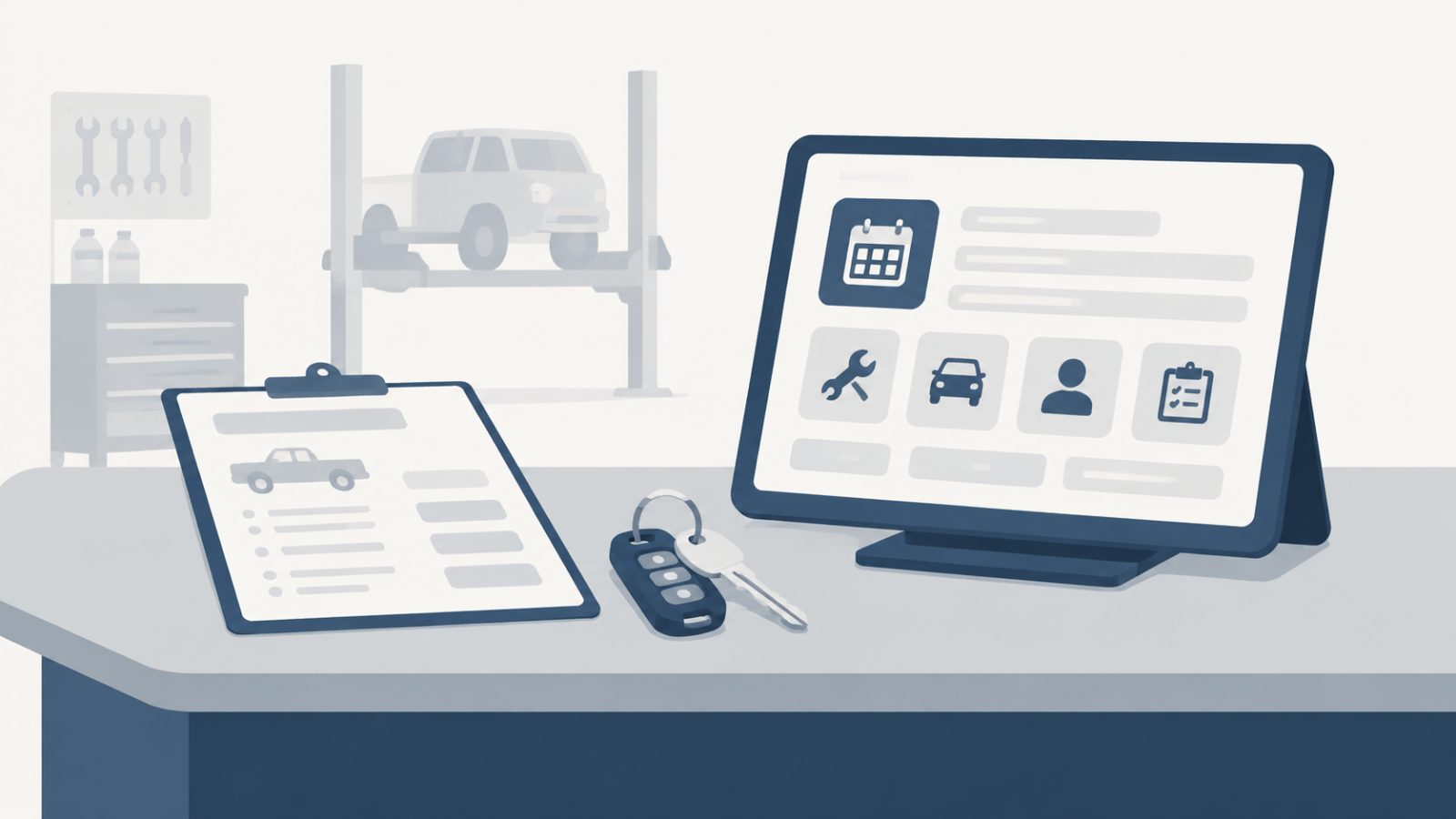
Book the inspection online, and pick a day the vehicle can be spared. Say on the booking that it is a work vehicle roadworthy. Mention the tray, the canopy, the tow bar and the trailer plug. A private car has none of them. The roadworthy certificates page covers what the inspection itself involves.
Bring the compliance plate details if the vehicle is a truck. Bring the defect notice itself if there is one, because it sets what happens next. Having both ready before the vehicle arrives saves a second visit.
Book an inspection and put the vehicle in on a quiet day rather than a busy one.
No fit-out is banned on a work vehicle. The check is whether it is bolted on properly, and whether it has covered something that must stay visible. A tray that has worked loose is the failure, not the tray itself.
That depends on the notice and on the time printed on it. Before that time, driving may still be allowed. After it, the vehicle needs a tow truck or a trailer to go anywhere. Read the notice first.
Yes, in two ways. The bar has to be built to the design rule, and it has to carry the marking that proves what it was rated for. Towing more than that marking allows is unsafe, whatever the vehicle can pull.
Not below the mass threshold, because it goes through the same system. Above the threshold, the truck belongs to the heavy vehicle scheme. That is a different inspection, done by testers approved for it.















Website By CJ Digital


